





It is a common problem for drivers not to measure the wear rate on their brake pads frequently enough.
The graph below shows how performance of the brake pad can be seriously affected as the pad wears down.
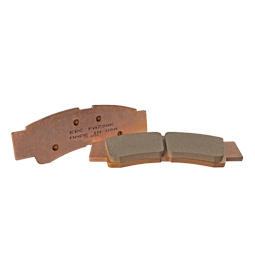
Most brake pads have a steel backing plate of four to five millimetres in thickness, and a friction material of 10 to 15 millimetres, making the available useable pad material about 5 – 10 millimetres.
The closer the braking surface gets to the backing plate, the higher the temperature becomes at the brake pad surface and the lower is the pad’s ability to dissipate heat.
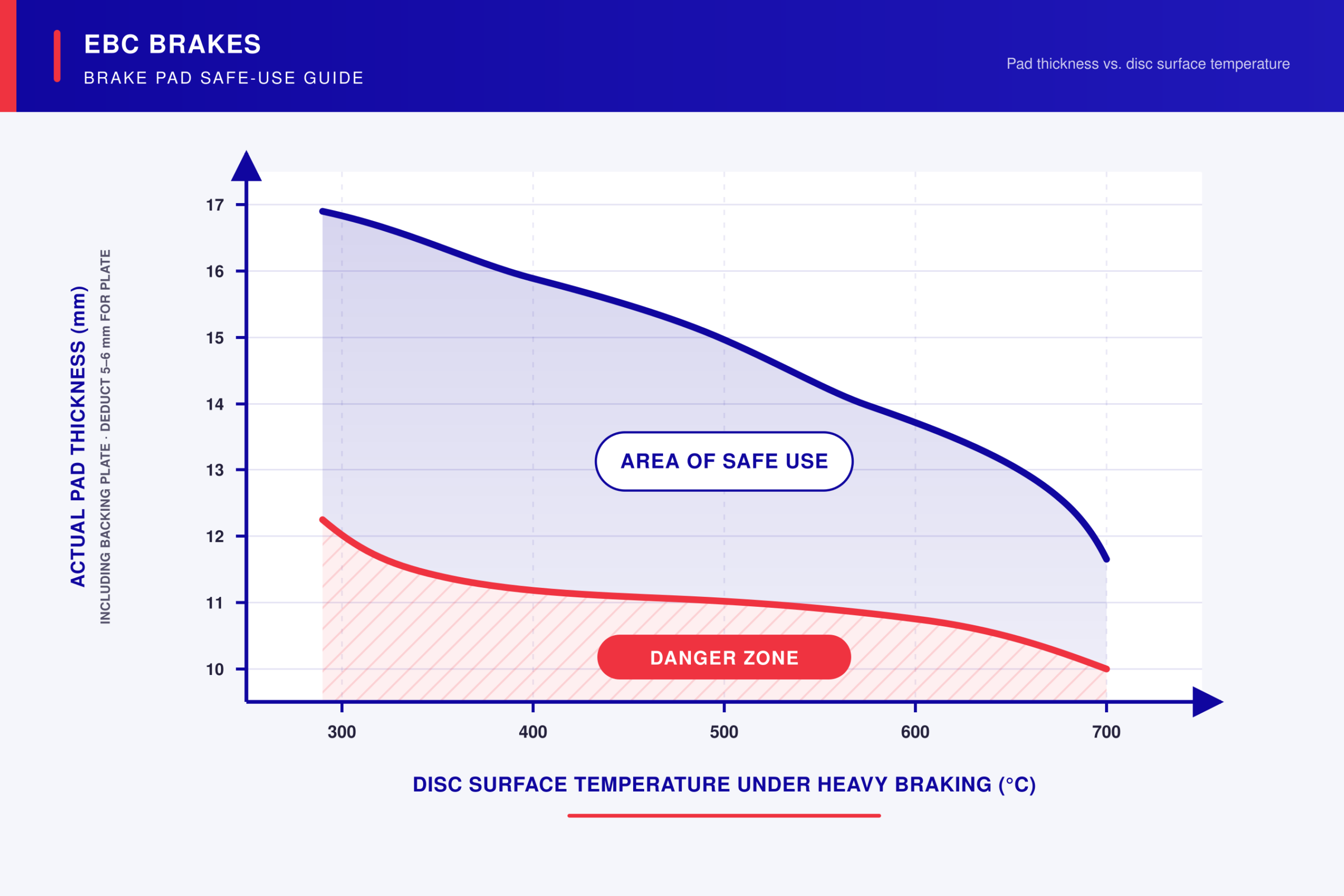
This is one of reasons a higher heat threshold pad is needed for performance driving.
Excess pad wear also means that pad temperatures or heat either get conducted into the caliper or reflected back into the brake disc (most common), causing elevated temperatures that the pad material struggles to handle and brake fade occurs.
It is recommended that brake pads are checked regularly during track days or hard driving sessions especially when racing and for track use – a pad that is approximately half worn needs to be changed out.
In general highway driving, when the friction material is reduced to approximately 2 millimetres above the backing plate, that definitely also needs to be replaced.
Not only does the pad’s ability to handle high heat reduce as the pad wears, but also the braking performance is severely reduced. So, in actuality, the pad life does matter and drivers are recommended to follow this guideline of minimum 2 millimetres above the back plate for street use or remove at half the original pad overall thickness for all types of track use.